
Celtic Betting Bankroll Management: Staking and Risk Control Guide
 Available in US
The fastest way to destroy any edge you might have in Celtic betting is to ignore bankroll management. You could identify value perfectly, predict outcomes with supernatural accuracy, and still end up broke because you staked inappropriately. Conversely, mediocre value identification combined with disciplined bankroll management will survive variance long enough to generate modest but sustainable returns. This is not theory; it is mathematical reality that plays out across every bettor’s experience whether they recognise it or not.
Bankroll management begins with a simple premise: your betting funds must be segregated from your living expenses and sized to survive inevitable losing streaks. If losing your entire bankroll would affect your rent, bills, or food budget, you have not established a proper bankroll. You have instead allocated household funds to gambling, which creates pressure that distorts decision-making and eventually leads to disaster. A genuine bankroll is money you can afford to lose completely without material lifestyle impact.
Establishing Your Starting Bankroll
The amount you start with matters less than committing to keep it separate and properly sized. Some bettors begin with one hundred pounds, others with ten thousand. What matters is that the amount reflects genuine discretionary income rather than money needed elsewhere, and that your stakes relate sensibly to this total rather than arbitrary amounts that feel right emotionally.
A common starting framework divides your bankroll into one hundred units. If you begin with five hundred pounds, each unit equals five pounds. Stakes are then expressed in units rather than currency, which helps detach decision-making from emotional reactions to specific pound amounts. Saying you will stake two units sounds more calculated than saying you will bet ten quid, even though the amounts are identical. The psychological distance matters.
The hundred-unit system provides sufficient granularity for proper stake sizing while remaining manageable. Your maximum stake on any single bet should probably not exceed five units regardless of confidence level. Most bets fall in the one to three unit range depending on perceived edge. This structure ensures no single loss devastates your bankroll while allowing you to stake more heavily when genuine value appears.
Your bankroll will fluctuate constantly. Winning periods expand your unit size since each unit remains one percent of your current total. Losing periods shrink unit size through the same mechanism. This automatic adjustment is crucial because it prevents stakes from becoming disproportionate to remaining funds. A two-unit bet when your bankroll has halved is half the currency value of a two-unit bet when full. The system protects you during downswings while allowing growth during winning streaks.
Flat Staking: The Simple Approach
The simplest staking strategy involves betting identical amounts on every wager regardless of perceived edge. If your standard stake is two units, every Celtic bet receives two units. No variation based on confidence, odds, or market type. Pure consistency across all situations.
Flat staking appeals through its simplicity and psychological clarity. You never agonise over how much to bet because the answer is always the same. You never compound bad decisions by increasing stakes after losses in misguided attempts to recover. You never over-bet based on false confidence in a particular selection. The approach eliminates numerous psychological traps that trip up less disciplined bettors.
The drawback is that flat staking ignores valuable information about edge size. If you identify a Celtic bet with enormous expected value alongside another with marginal expected value, flat staking treats them identically. Optimal strategy would stake more heavily on the larger edge. By flattening stakes, you sacrifice potential returns in exchange for simplicity and consistency.
For most recreational Celtic bettors, flat staking represents the sensible choice. Its limitations matter most to sophisticated bettors placing large volumes of bets across diverse situations. If you bet on Celtic perhaps twenty times per season and treat it as informed entertainment rather than professional endeavour, flat staking removes unnecessary complexity while maintaining discipline.

Percentage Staking: Scaling With Your Bankroll
Percentage staking maintains a consistent proportion of your current bankroll as your maximum stake, automatically adjusting nominal amounts as funds grow or shrink. If you stake two percent per bet on a one-thousand-pound bankroll, each bet is twenty pounds. After profits grow your bankroll to twelve hundred pounds, each bet becomes twenty-four pounds. After losses reduce it to eight hundred, stakes drop to sixteen pounds.
This approach provides the same automatic adjustment as the unit system while framing decisions differently. Some bettors find percentage thinking more intuitive than unit thinking because it constantly relates stakes to current reality rather than original amounts. The discipline is identical; only the mental framing differs.
Percentage staking works particularly well for bettors whose bankroll changes significantly over time. If you start small and grow substantially through successful betting, percentage staking ensures your stakes remain proportionate rather than becoming trivially small relative to accumulated capital. Similarly, during extended drawdowns, stakes shrink to protect remaining funds rather than continuing at levels designed for a larger bankroll.
The key decision is selecting your percentage. Conservative bettors might stake one percent per bet, meaning a hundred consecutive losses would be required to empty the bankroll entirely. Aggressive bettors might stake three to five percent, accepting higher volatility for faster potential growth. Most Celtic bettors find two percent strikes a reasonable balance between growth potential and survival probability.
The Kelly Criterion: Optimal But Demanding
The Kelly Criterion represents mathematically optimal staking when you can accurately estimate your edge on each bet. Developed by Bell Labs researcher John Kelly in 1956, the formula determines the exact stake that maximises long-term bankroll growth while minimising ruin risk. Professional bettors and financial traders have applied Kelly principles for decades across various contexts.
The formula is elegantly simple: stake equals edge divided by odds minus one. If you believe Celtic have a 70% chance of winning at 1.50 odds, your edge is 70% minus 67% (the implied probability) equals 3%. The Kelly stake would be 3% divided by 0.50 (the odds minus one), equaling 6% of your bankroll. Higher edges and shorter odds produce larger Kelly stakes; smaller edges and longer odds produce smaller stakes.
Kelly’s mathematical optimality comes with significant practical challenges. The formula requires accurate probability estimates, and most bettors chronically overestimate their edge. Betting 6% of your bankroll when you genuinely have 3% edge is optimal; betting 6% when you actually have 0.5% edge accelerates ruin. The formula punishes overconfidence severely, making it dangerous for bettors without extremely well-calibrated probability assessments.
Professional bettors typically use fractional Kelly, staking some fraction of the mathematically optimal amount. Half-Kelly stakes half the recommended amount, providing smoother bankroll growth at the cost of slower long-term returns. Quarter-Kelly provides even more cushioning against estimation errors. This modification acknowledges that perfect probability estimation is impossible while retaining Kelly’s core insight that stakes should scale with edge size.
For Celtic betting specifically, Kelly presents additional challenges because edges tend to be small when they exist at all. A 2% edge on a Celtic match produces Kelly stakes around 4% of bankroll, which feels substantial for a single bet. The volatility of such aggressive staking often proves psychologically difficult to sustain through inevitable losing streaks. Most Celtic bettors would find fractional Kelly approaches more practical than full Kelly implementation.
Handling Losing Streaks
Every bankroll management system must survive losing streaks because every bettor experiences them. Positive expected value does not prevent consecutive losses; it merely ensures eventual profitability over sufficient sample sizes. A Celtic bettor making fifty positive expected value bets annually might easily experience ten-bet losing streaks within that sample. How your staking approach handles these streaks determines whether you remain solvent long enough for probability to assert itself.
The cardinal rule is never increasing stakes to chase losses. The temptation after losing several Celtic bets is to bet larger on the next opportunity, reasoning that you are due for a win and need to recover losses quickly. This logic is fatally flawed. Each bet stands independently; past results provide no information about future outcomes. Increasing stakes after losses merely accelerates potential ruin while providing no genuine compensating benefit.
Proper staking systems inherently reduce nominal stakes during losing streaks because your bankroll has shrunk. If you started with one thousand pounds staking twenty per bet, and losses reduce you to seven hundred, your stakes should now be fourteen pounds. This automatic reduction protects your remaining capital while maintaining consistent risk relative to current resources. Fighting this adjustment by maintaining original stake levels is a common path to complete bankroll destruction.
Emotionally surviving losing streaks requires detachment from short-term outcomes. If your process is sound, losing streaks represent variance rather than evidence of error. Review your bet selection to confirm you are indeed finding value, but avoid overcorrecting based on small samples. Ten consecutive losses can occur with positive expected value betting; they do not prove your approach is wrong. Only sustained underperformance across hundreds of bets provides meaningful signal about actual edge.

Practical Implementation for Celtic Bettors
Implementing bankroll management for Celtic betting need not be complicated. Start with these practical steps that establish discipline without overwhelming complexity.
First, define your bankroll explicitly. Write down the amount you are committing to Celtic betting for this season. Deposit this amount with your preferred bookmaker or bookmakers, and consider it your complete betting fund. Funds in your regular bank account are not available for betting; only the designated bankroll counts.
Second, choose a simple staking approach and commit to it. Flat staking two percent of current bankroll represents a sensible default for most bettors. Write this rule down alongside your bankroll figure. Before placing any bet, calculate your current bankroll and stake two percent. No exceptions based on confidence, recent results, or emotional state.
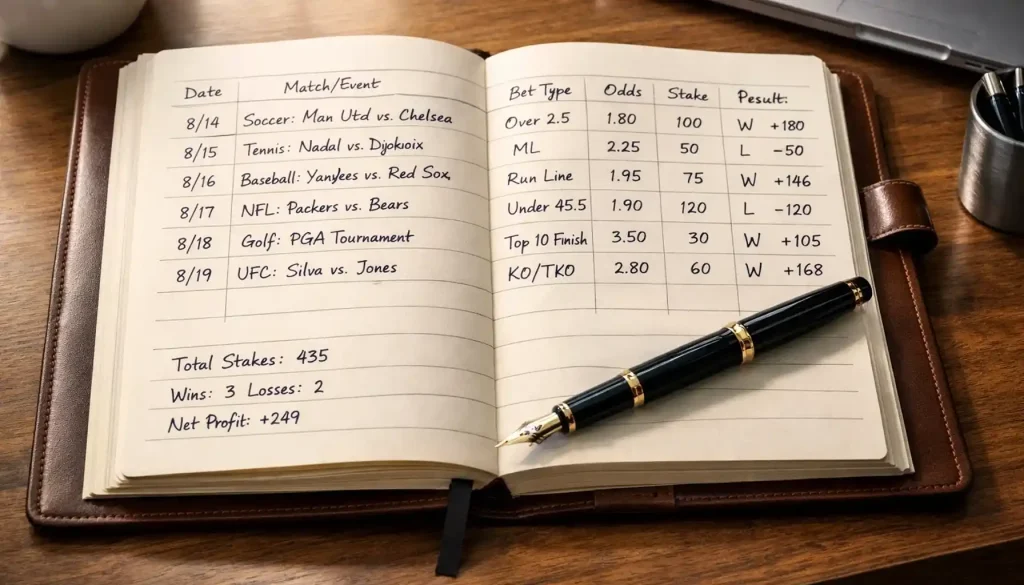
Third, track every bet with honest detail. Record the date, match, market, odds, stake, and outcome. Calculate your bankroll after each bet. Over time, this record reveals patterns in your betting that would otherwise remain invisible. Are your Celtic home bets performing better than away bets? Are certain markets generating edge while others destroy it? Without records, you cannot answer these questions.
Fourth, review periodically and adjust if evidence warrants. After perhaps fifty Celtic bets, examine your records honestly. If you have sustained losses despite believing you were finding value, consider whether your value identification or your staking discipline failed. Refine your approach based on actual evidence rather than assumptions about what should work.
The Connection Between Bankroll and Betting Quality
Good bankroll management and good bet selection reinforce each other. When stakes are appropriately sized relative to bankroll, each individual bet carries manageable downside regardless of outcome. This removes desperation from decision-making, allowing you to pass on marginal situations and wait for genuine value without feeling pressured to generate action.
Conversely, poor bankroll management corrupts bet selection even when analytical skills are sound. Bettors who have over-bet and suffered significant losses often chase increasingly speculative wagers trying to recover. They know these bets lack value but place them anyway because their bankroll situation feels urgent. The betting quality spiral continues downward until complete ruin arrives.
Celtic betting should enhance your enjoyment of football, not create financial stress that bleeds into other life areas. Proper bankroll management is ultimately about maintaining this healthy relationship with betting. Stakes sized appropriately to your financial situation ensure that outcomes remain entertainment rather than crisis. Win or lose on any Celtic match, your life continues normally. That psychological freedom is the foundation everything else builds upon.
Published:
