

LiveTV review: how the sports platform works
LiveTV brings sports video, links to live broadcasts, fixture schedules and match information into a single browsing experience. This guide explains how to use those features and what the site’s terms mean for viewers in the United Kingdom.
- Sports video plays through LiveTV, while broadcast sources can come from other providers.
- Fixtures, results and individual match pages offer different routes into the same sporting event.
- Account features, community contributions and advertising are addressed in the site’s published terms.
Watch sports on LiveTV
Open the sports homepage to explore its current sections and events.
LiveTV: features and viewing conditions
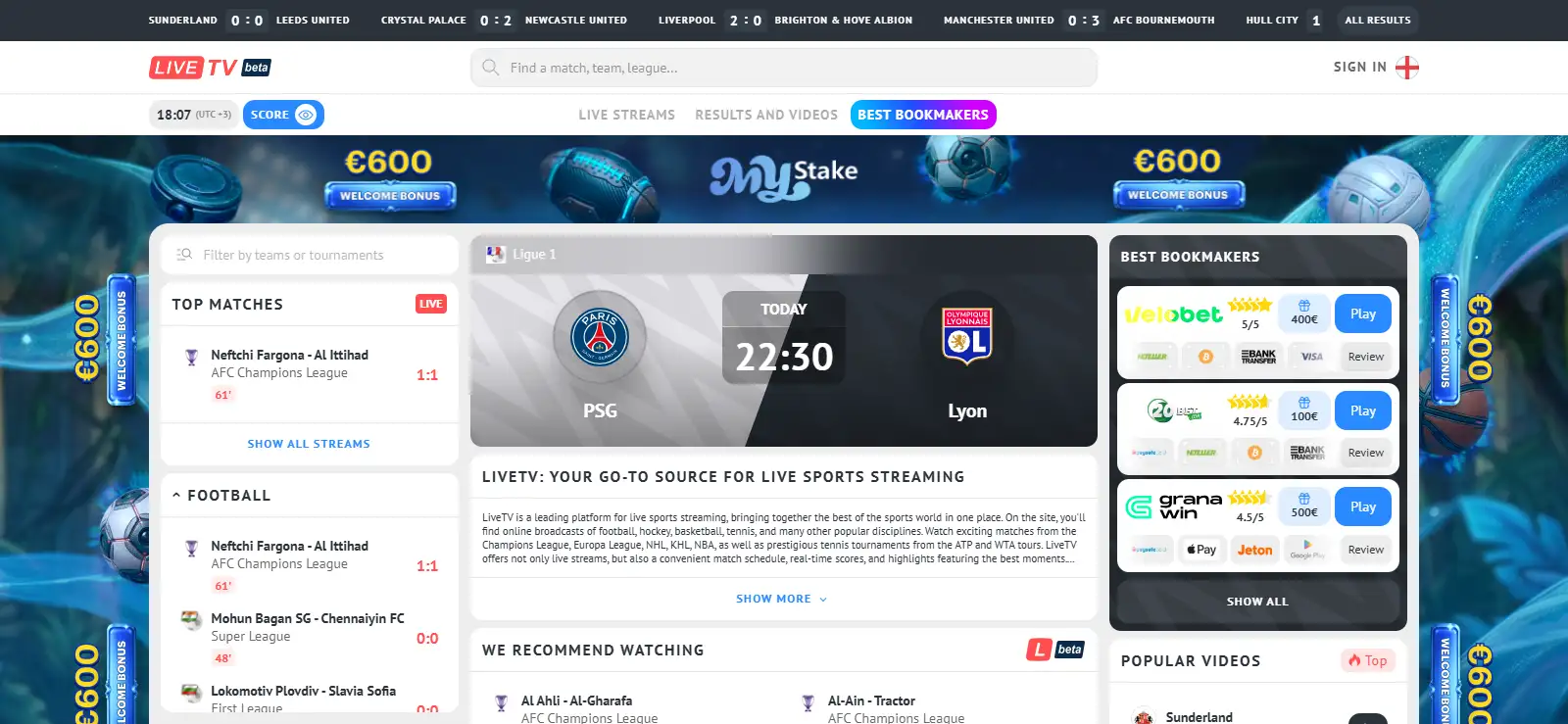
LiveTV is a sports website built around videos, broadcast links, fixtures, results and match information. Its starting point is a mixture of recommended events, sport-specific listings and football competitions, while dedicated pages add statistics and videos for individual fixtures. That structure makes it possible to start with a sport, find an event and then move between viewing and background information without treating each function as a separate service.

- Watching: sports videos play through the site, with event pages linking to available broadcast sources.
- Following: fixture, results and tournament views place an individual game in a wider schedule.
- Exploring: club pages, video sections and editorial articles provide routes beyond a single match.
The homepage groups material under headings such as “We recommend watching”, “Broadcasts”, “Results and videos” and “Football leagues”. Recommended events change with the sporting calendar, so these blocks are best understood as entry points rather than a fixed collection of fixtures. LiveTV also advertises HD/FHD streams and viewing without signing up; those are the site’s claims about its service, not a promise about each individual source.
| Site format | Sports video, broadcast links and match-information website |
|---|---|
| Website | LiveTV’s English-language web interface |
| Video viewing | Sports video is available for playback through the site |
| Broadcast sources | Event pages can direct viewers to third-party sources |
| Sports presented | Football, ice hockey, basketball, tennis and other disciplines |
| Match information | Scores, events, line-ups and statistics where shown |
| Scheduling | Upcoming sports page and tournament calendars |
| Results and video | Results views, match reviews, goals and individual video pages |
| Registration | Sign-in and account creation are presented for additional features |
| Further content | Sports-betting articles and a bookmaker comparison page |
| User terms | Agreement and policy pages describe content, accounts and advertising |
| Regional streams | Availability depends on the particular event and video source |
Different parts of LiveTV answer different questions. The schedule helps with what is coming up; the match page helps with what happened or is happening; and the video sections help locate moving images associated with that event. Reading the navigation in this order keeps the service straightforward even when a fixture has several related pages.
LiveTV review of video sources and user terms
The way LiveTV handles sporting content is central to using it well. Videos can be played through the website, and match pages can list sources for live broadcasts. At the same time, LiveTV describes itself in its published policies as an aggregator of external links and user-contributed material rather than a host that keeps the video files on its own servers. For viewers, that distinction explains why the site and an individual video provider can play different roles.

How viewing and source links fit together
A fixture is usually the organising unit. You can enter from a broadcast listing or a match page, then use the relevant video area or source name to approach the content available for that event. The site supports sports-video playback, but the provider behind a particular stream shapes practical details such as its technical performance, conditions and geographical reach. A stream link is therefore more useful when treated as an event-specific option, not a standing guarantee of access.
The LiveTV user agreement describes the site’s approach to third-party media, shared links and user publications. According to those terms, the operator does not store video and other media on its own servers, and it does not guarantee the quality, availability or lawfulness of material found through external sources. For a viewer, the practical point is to consider the source behind a broadcast, especially before sharing personal details or relying on a particular video being available later.
Accounts and community participation
LiveTV displays sign-in and account-creation options, and presents registration as a way to gain extra functions, including following favourite teams or players. Its homepage also promotes viewing without registration. These two messages cover different uses: opening publicly presented content and taking part in personal or community features. What any individual third-party player requires is determined by its own conditions rather than by a homepage statement about the service overall.
The agreement sets a minimum site-registration age of 16 and covers comments and other user submissions. This is a condition stated by LiveTV for its site, not an age rule for gambling. Its match interface also contains an “Add link to broadcast” form with fields for a link, language and bitrate, signalling that visitors can encounter a contribution route alongside ordinary viewing features. Submissions remain subject to the site’s published rules.
Advertising, data and editorial material
LiveTV’s published policy explains categories of data associated with running the site, including account details, browser or device information, IP addresses and cookies. It describes uses such as operating the service, moderation, analytics, advertising and partner content. The policy also distinguishes advertisements from editorial recommendations. That context helps readers understand why sports coverage and bookmaker-related material can appear in the same navigation.
The site says user-submitted material may be publicly visible, and its rules provide for moderation or removal of inappropriate contributions. A reader considering comments or sharing a broadcast link should therefore treat the submission as public-facing content and follow the platform’s guidelines. There is no need to create an account simply to understand the scores, listings and editorial sections discussed here.
Use the platform information
- Read the event card before opening a listed source.
- Review site terms before creating an account or submitting content.
- Separate the site’s editorial comparisons from independent operator information.
Keep the conditions in view
- Do not assume one stream represents every provider.
- Do not treat a public comment or link submission as private correspondence.
- Do not interpret a bookmaker mention as a bet taken by LiveTV.
Live streams: schedules and viewing conditions
LiveTV groups upcoming sport in a dedicated schedule and puts video routes alongside event pages. The upcoming sports schedule displays a Today/Upcoming choice, a strip of dates, sports categories and a search field for a team or tournament. Those visible controls give viewers recognisable ways to orient themselves by time and sport before moving towards an event.
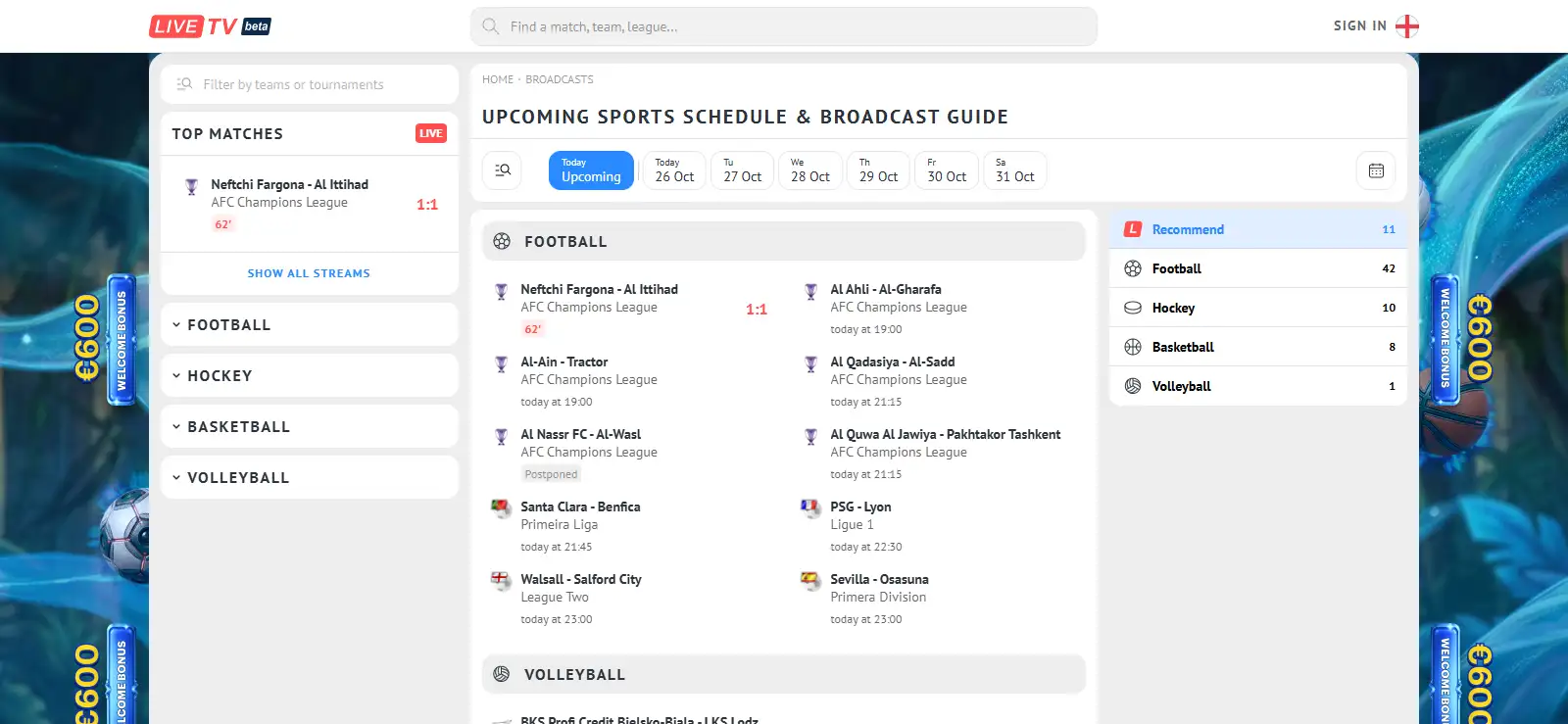
Finding a fixture in the schedule
The homepage offers “Now” and “Upcoming” categories under its broadcasts area. The schedule then places the calendar and sporting categories at the centre of the journey. A football viewer, for instance, can approach the fixtures from the football category instead of searching through an unrelated hockey or basketball list. Since a sporting calendar changes continuously, event counts and precise start times belong to the current listing rather than to a permanent description of the site.
LiveTV names football, ice hockey, basketball, tennis and other disciplines in its coverage descriptions. Its coverage descriptions mention competitions such as the NBA, ATP and WTA events, and the UEFA Champions League. These are examples of the site’s stated scope. A tournament’s appearance in the site’s navigation does not by itself establish that a particular match has a working live video source on any given date.
How to move from a listing to video
- Start with broadcasts or the schedule.
Open the sports listing and identify the event, date or discipline you want to follow. - Open the event card.
The dedicated match page provides the named teams, competition and any relevant tabs for that event. - Look for the video or source area.
Where a broadcast source is listed, the match page can present it in a Playlist or related video section. - Choose the available material.
Use the site’s video playback or the event’s available source route, taking account of the provider and its conditions.
Video on LiveTV is not limited to a fixture that is about to start. The homepage includes “Results and videos”, and completed match pages can organise clips under headings such as “Reviews”, “Match review” and “Goals”. If you have missed a game, following its result into those sections is a different and useful route from browsing the live schedule. The exact selection of clips is tied to the event rather than a promise of a comprehensive permanent archive.
The football results section adds another entry point for tracking a completed fixture. Its description covers live scores, full-time results, goal information and standings. Readers who already know a result can use that context to decide whether a match page, goals section or tournament calendar is the next most useful destination.
Tournaments connect fixtures and standings
Individual events sit within broader league pages. The Premier League competition page, for example, is one of the documented tournament destinations, with sections for broadcasts, results and videos, a calendar and a league table. Some competitions display groups, while others use a single table; columns can cover fixtures played, wins, draws, defeats, goals, points or recent form.
This matters when your interest lasts longer than a single match. A fixture listing tells you what is next, while a league calendar and table show where the contest sits within the competition. Club pages provide a further route through tabs such as Profile, Broadcasts, Results and videos, Calendar and Composition. Together these structures give a useful navigation path from sport to tournament, fixture and team.
Match pages: scores, statistics and context
Individual match pages bring together the information that is scattered across a general sports schedule. They identify the participating teams and competition, show a current or final event status and provide relevant areas for video, events, statistics and results. This turns a selected fixture into a hub for both watching and understanding the sporting action, with the exact tabs depending on the match and its stage.
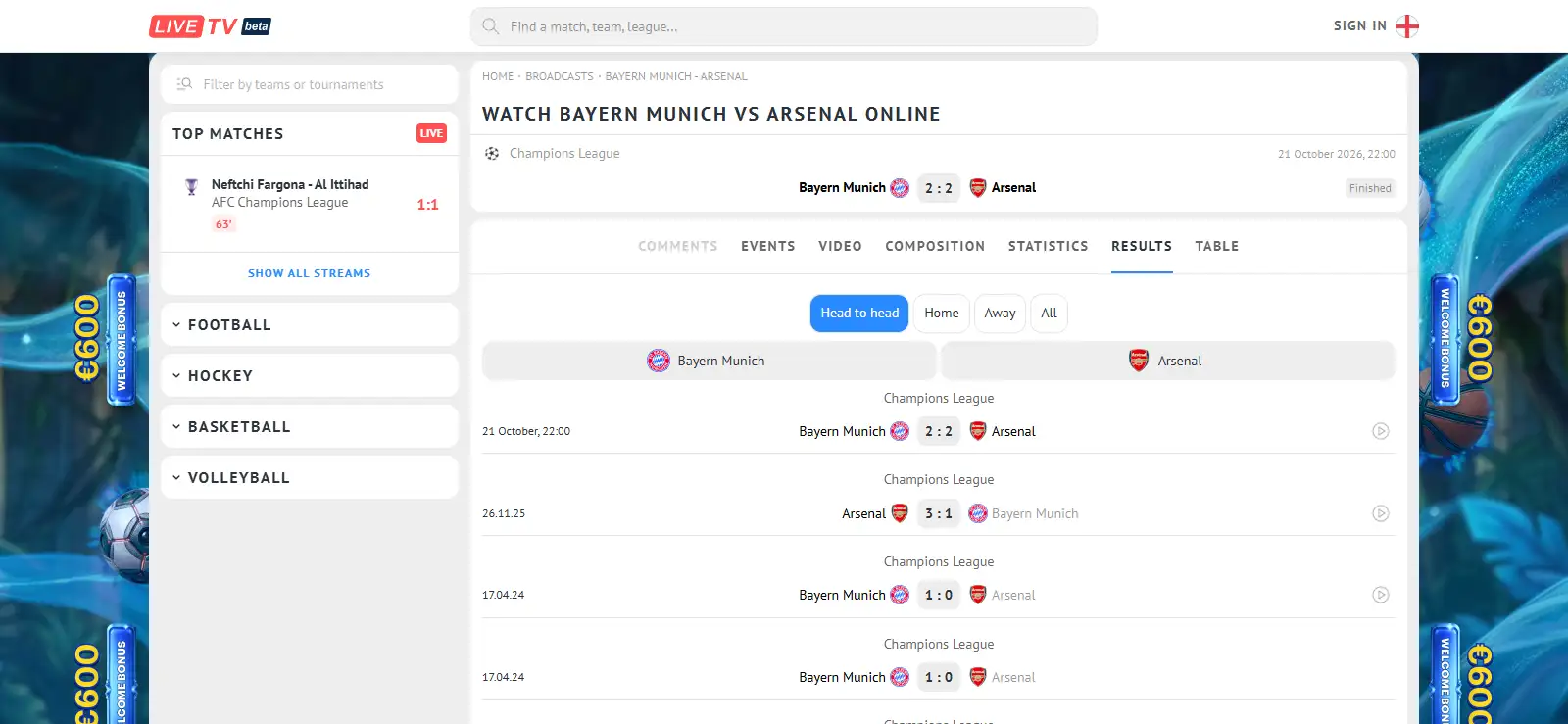
Reading the match card
A football fixture can include team line-ups, reserve players and coaches, events marked by minute, and comparisons of the two sides’ statistics. Typical recorded events include goals, substitutions and cards, while a detailed statistics display can cover possession, shots, shots on target, corners, fouls, offsides or saves. The numbers update with the match and should be read as event-specific information, not universal fields for every sport.
The Bayern Munich–Arsenal match page illustrates a completed football event with match-review, goals and statistical material. It is a concrete example of how a finished game can still be navigated after the live phase has ended. The score and the available clips belong to that particular fixture; its role here is to explain the page’s functions rather than to make a prediction about another match.
| Match-page area | What it contains | Why it helps |
|---|---|---|
| Event header | Teams, competition and match status or score | Confirms that you have opened the intended fixture |
| Playlist or Video | Listed sources or match-related video where available | Connects the fixture to footage or broadcast options |
| Events | Time-stamped match incidents | Shows the sequence of significant moments |
| Composition | Starting players, substitutes and coaches where shown | Places the contest in a team-selection context |
| Statistics | Sport-specific figures and comparisons | Adds detail beyond the score |
| Head to head | Previous meetings, sometimes with home/away filters | Offers background for understanding the pairing |
| Table and Results | Competition position and other fixture outcomes | Links one result to the wider tournament |
For viewers who want to understand the match rather than only see the final score, the Events and Statistics areas answer different questions. A chronology explains when the key incidents occurred. A possession or shots comparison describes how the game developed. Head-to-head records and league tables then widen that context to previous meetings and the ongoing competition.
Live links, completed events and video reviews
LiveTV has match pages that display a Playlist and named broadcast sources; one documented football card includes a source labelled “aliez”. Other event pages show different providers and a bitrate label. Those labels describe entries on particular cards, not a uniform stream catalogue. When a match is completed, its page can instead direct attention to a video review, goals or the event’s recorded statistics.
The change of emphasis is useful. Before or during a fixture, a viewer may mainly want the broadcast area and event status. Afterwards, the match review and statistical record become more relevant. A page title that still contains the words “live stream” does not automatically mean that live play is continuing after the event has finished.
Sports and betting articles: topics to explore
LiveTV includes editorial areas about sports betting alongside its viewing and match-data functions. The sports betting section serves as a thematic entry point, while the site’s navigation presents named guides covering individual sports. These are reading and reference destinations; the presence of a betting article does not mean that LiveTV itself accepts wagers or carries out deposits.
Choosing material by sport
The site’s category links include subjects such as football, volleyball, water polo, table tennis, Gaelic football and boxing. That range gives readers a way to locate a topic relevant to the match they are following rather than searching only by bookmaker name. The titles establish the editorial subjects; any detailed explanation of bets, prices or conditions needs to be read on the relevant article itself.
There is also a distinction between editorial subjects and the sporting information elsewhere on the site. A football results page reports match information, while a betting guide addresses betting as a topic. The bookmaker comparison page then discusses characteristics of external operators. Keeping these purposes separate helps a reader use each area for the question it is designed to answer.
| Section | Type of information |
|---|---|
| Sports betting landing area | Introduction to the site’s betting-related editorial topics |
| Sport-specific guides | Named article topics such as football, volleyball and boxing |
| Bookmaker comparison | LiveTV’s own comparison of selected external operators |
| Sport and match pages | Fixtures, results, event details and available sporting video |
For someone interested primarily in football or another sport, these article links can be treated as an optional reference path after the match information. A user looking for the original sporting event does not have to pass through betting content to understand the schedule or find the match card. The distinction is especially important when an editorial page includes commercial claims that can change over time.
Bookmaker comparisons: information on offer
LiveTV has a dedicated bookmaker comparison that looks at external betting services. The page is a feature-by-feature editorial guide rather than a betting account within LiveTV. Its published comparison covers six operators, and the article dates its information review to 13 July 2026. It is therefore useful as a guide to the topics being compared, with operator details understood as the publication’s own dated claims.
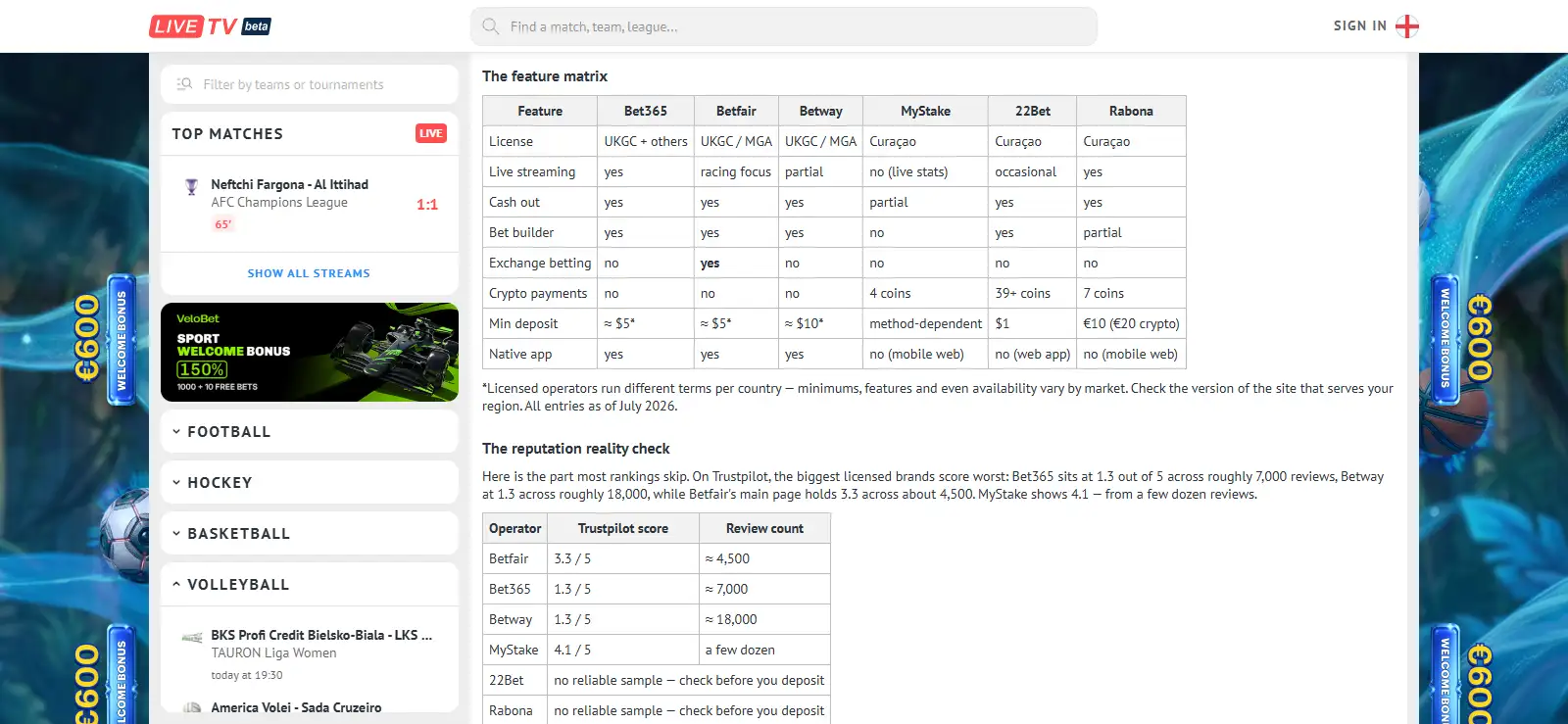
What the comparison discusses
Among the six operators it compares, the page names 22Bet, Rabona, Bet365 and Betfair. It examines topics such as live streaming, cash out, bet builders, betting exchanges, payment options and responsible-gambling features. It also discusses licensing jurisdictions, review-site ratings and withdrawal speeds. These are useful headings for reading an operator profile, not independently verified claims about current terms or access from the United Kingdom.
The article distinguishes a conventional bookmaker from a betting exchange. That distinction helps explain why otherwise similar services can present different ways of placing a bet. It also shows why a simple order of names cannot replace a look at each company’s own product, terms and local status. Any operator’s market coverage, payment options or advertised features are subject to change.
Using the list as a reference, not as a transaction
A sensible reading route is to identify the comparison categories you care about, open the relevant operator’s official terms separately, and consider the rules that apply where you live. LiveTV’s article includes jurisdiction and age caveats, but its figures and assessments belong to that dated editorial publication. This approach preserves the value of the comparison as an overview without treating the page itself as a live confirmation of every claim.
Payments and bonus offers are mentioned among the comparison topics, yet the available material does not establish a single set of deposits, withdrawals or offers for British readers. Rather than transferring an amount or promise from one operator to another, use the headings as questions to ask of the particular service. LiveTV remains the sports information and editorial destination in this arrangement; any actual account or transaction belongs to the external operator.
LiveTV in the United Kingdom: language and access
For readers in the United Kingdom, LiveTV’s English-language interface gives a straightforward starting point for its homepage, schedules, match cards and editorial pages. The browser-based routes described in this guide lead to the documented LiveTV site rather than to a separate country-specific address. English is the language of the pages covered here, and the service presents sporting data and video-related sections through those pages.
Practical questions about LiveTV
Does LiveTV host the sports streams itself?
No. Its published terms describe an aggregation service that links to material from outside providers rather than storing video on LiveTV’s own servers. The site nevertheless supports playback of sports videos through its interface.
Is every video on LiveTV free to watch?
LiveTV promotes sports viewing without registration, but that statement does not settle the price or access terms of every external source. Check the conditions of the particular video you choose.
How does viewing work, and do I need to register?
Start from a broadcast listing or match page, then select the available video material or listed source. LiveTV advertises viewing without an account and presents registration for additional functions such as following teams and players.
Which language does this LiveTV site use?
The website version covered here uses an English-language interface. Its menus include sporting schedules, results, match information and editorial sections.
Which sports and competitions appear on LiveTV?
The site presents football, ice hockey, basketball, tennis and further disciplines. Its own coverage descriptions mention competitions such as the NBA, ATP and WTA events, and the UEFA Champions League; an individual live broadcast depends on the fixture and source.
How old must someone be to register with LiveTV?
The site’s user agreement permits registration from age 16. That is a rule about using LiveTV, not permission to gamble; betting eligibility follows separate local requirements.
What responsible-gambling advice does LiveTV publish?
Its policy recommends observing the legal age, setting limits, avoiding attempts to chase losses and seeking help when gambling causes problems. These are general safety messages rather than a guarantee about an external bookmaker’s protections.
How does LiveTV handle advertising and partner content?
LiveTV’s policy discusses advertising and affiliate material alongside editorial content and says advertising is distinct from an editorial recommendation. It does not establish a complete breakdown of the site’s revenue.
Where LiveTV fits into following sport
LiveTV is useful as a joined-up route from a sports schedule to a match page and its related video or statistics. The browsing structure suits someone who wants to find a forthcoming event, check a football result, revisit a match review or follow a competition across several fixtures. Its match cards add context to the score, while its club and league sections offer pathways for continuing beyond one game. Understanding that videos can come from outside sources makes those functions easier to use on their own terms.
Best use of the site
Begin with the schedule for upcoming sport, or with results if the match has ended. Open the relevant event page for scores, video areas and detailed match information, then move into a tournament or club page for wider context.
For bookmaker reading, treat LiveTV’s comparison as a dated editorial overview and check current operator information separately. The sports sections stand on their own as a navigation and video-information resource.
Open LiveTV
Go to the homepage to choose the current sporting event or section.
This guide describes LiveTV’s sporting and editorial features; it is not the platform operator and does not take bets. The site describes advertising and partner content in its policies. Gambling involves risk, and external betting services have their own terms, eligibility requirements and local restrictions.
