
Old Firm Derby Betting: Rangers vs Celtic Guide
 Available in US

The Old Firm derby between Rangers and Celtic isn’t just another football match—it’s a cultural phenomenon that transcends sport, carrying historical, religious, and social dimensions that make it unlike any other fixture in British football. From a betting perspective, this complexity creates opportunities and dangers in equal measure. Everything you think you know about Celtic betting goes out the window when Rangers are the opposition.
Understanding What Makes Old Firm Different
Most football rivalries are about local pride or competitive history. The Old Firm runs deeper, rooted in Glasgow’s sectarian divisions dating back over a century. Celtic, founded to support the Irish Catholic immigrant community, versus Rangers, historically associated with Protestant Unionism. These religious and political undertones create intensity that affects everything from crowd atmosphere to player psychology to referee decisions.
For bettors, this intensity manifests as unpredictability. Form becomes largely irrelevant—Celtic might be dominating the league while Rangers struggle, yet the derby produces a Rangers victory because motivation and occasion override quality gaps. I’ve watched Celtic thrash everyone for months, arrive at Ibrox as overwhelming favorites, and lose because the pressure of the fixture got to them. Conversely, Rangers sides nowhere near Celtic’s quality somehow raise their performance to competitive levels when these teams meet.
The historical head-to-head record shows remarkable balance despite periods where one club dominated domestically. This parity in derby results contrasts sharply with their league positions, creating betting dynamics where backing the favorite at short odds often represents poor value. The occasion levels the playing field in ways that don’t occur in normal matches, making Old Firm betting as much about psychology as quality.
Media attention amplifies everything. In the week leading up to Old Firm matches, Scottish sports coverage becomes almost exclusively focused on the fixture. Player comments are scrutinized for perceived disrespect, tactical analyses dominate discussion, and the pressure builds to suffocating levels. This environment affects how teams approach the match—conservative tactics to avoid humiliation sometimes trump attacking ambition, creating cagey affairs despite the attacking talent on display.
The sectarian element, while less pronounced than historically, still influences match atmosphere and behavior. Celtic Park and Ibrox become cauldrons of noise and intimidation when hosting Old Firm derbies. Players unfamiliar with the fixture’s intensity often look overwhelmed in their first derby. Conversely, players who thrive in high-pressure environments can elevate their performances beyond their usual level. Understanding which players cope with or crumble under Old Firm pressure helps predict individual performances.
Home Advantage: More Significant Than Usual
Home advantage exists in all football matches, but Old Firm derbies magnify it beyond normal levels. The 60,000 at Celtic Park or 50,000 at Ibrox aren’t just spectators—they’re participants whose noise and intimidation genuinely affect performance. Opposition players describe the atmosphere as overwhelming, with constant noise making communication difficult and psychological pressure affecting decision-making.
Statistical analysis of recent Old Firm results shows home teams win significantly more often than away teams, with draws being the next most common outcome. Away victories happen but remain the least frequent result, creating a clear hierarchy: home win most likely, draw second, away win least likely. This pattern persists across different periods of relative strength for each club, suggesting home advantage is structural rather than dependent on which team is currently stronger.
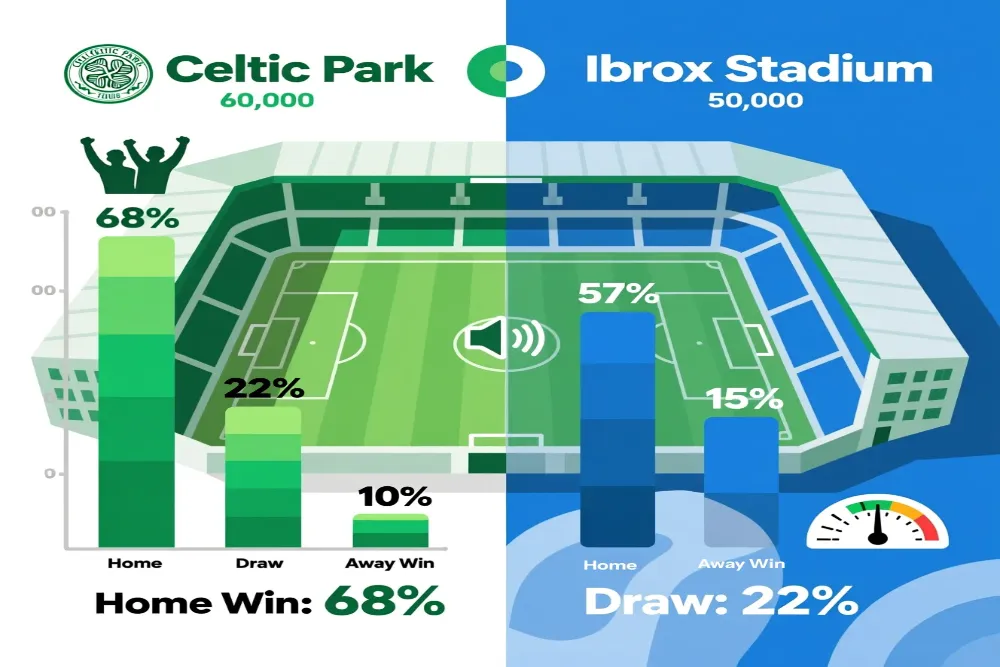
From a betting perspective, this home advantage should be priced into odds, and it usually is—but not always to the correct degree. When Celtic travel to Ibrox as league leaders with Rangers struggling, the odds might still favor Celtic but not sufficiently account for how the hostile environment and occasion level the competitive gap. Similarly, Rangers at Celtic Park face an atmosphere that can intimidate even when Rangers are the superior team on paper.
The psychological dimension of home advantage in Old Firm matches extends beyond crowd noise. The home team has slight tactical advantages—familiar pitch dimensions, comfortable dressing rooms, usual routines. These small factors compound into meaningful edges when matches are decided by fine margins. In fixtures where emotions run high and both teams are motivated, these marginal advantages often determine outcomes.
Understanding when home advantage is underpriced versus accurately priced separates profitable Old Firm betting from casual wagering. If bookmakers have simply applied standard home advantage adjustments without accounting for Old Firm’s unique intensity, value might exist on home teams. Conversely, if public sentiment has pushed home teams to prohibitively short odds beyond what historical results justify, contrarian value exists on away teams or draws.
Form Goes Out the Window: Why Recent Results Don’t Matter
The most consistent pattern in Old Firm betting is that recent form poorly predicts derby results. Celtic might arrive unbeaten in fifteen matches, scoring goals freely and looking invincible. Then they draw or lose to Rangers because the occasion creates different dynamics than normal matches. The pressure to perform in Scotland’s biggest fixture can cause the better team to tighten up while the underdog plays without pressure.

This form irrelevance has two implications for betting. First, don’t over-weight recent results when assessing Old Firm probabilities. That Celtic demolished Aberdeen 5-0 last week tells you less about this match than it would for a normal fixture. Second, value often exists precisely because casual bettors do weight recent form heavily, creating odds that don’t reflect how Old Firm dynamics differ from standard matches.
Historical derby results provide more predictive value than recent form. If Rangers have won the last three Old Firm meetings despite Celtic dominating the league overall, that pattern suggests psychological or tactical factors favoring Rangers in these specific matches. Momentum and confidence within the derby itself matter more than broader season form, creating betting angles unavailable in normal fixtures.
The occasion can paralyze favorites while liberating underdogs. When Celtic are expected to win, players feel pressure to deliver, which can manifest as cautious play and risk-aversion. When Rangers are expected to lose, players have freedom to express themselves without fear of criticism if things go wrong. This psychological dynamic explains some surprising Old Firm results where quality gaps didn’t manifest as expected.
Player performances in Old Firm matches often differ from their standard levels. Some players thrive on the pressure and intensity, producing career-best performances. Others wilt under scrutiny, making uncharacteristic errors or disappearing from the match entirely. Tracking individual players’ Old Firm histories helps predict who will step up versus who might struggle, informing player prop bets and overall match assessments.
Tactical Approaches: Caution Often Prevails
Despite the attacking talent both teams typically possess, Old Firm matches often become tactically cautious affairs. Managers know that losing carries consequences beyond three points—fan backlash, media criticism, and psychological damage for subsequent matches. This fear of losing sometimes overrides ambition to win, creating cagey matches where both teams prioritize not conceding over aggressive attacking.
The first goal becomes psychologically massive. The team that scores first gains confidence while the trailing team faces pressure to equalize quickly, which can lead to tactical adjustments that open the match. But until that first goal, both teams often probe cautiously, unwilling to commit too many players forward and risk being caught on the counter. This explains why many Old Firm matches see goals arrive in clusters—once the stalemate breaks, the match opens up.
From a betting perspective, these tactical tendencies affect multiple markets. First-half draws occur frequently because neither team wants to concede early, making the half-time result draw an interesting bet. Both teams to score becomes attractive because once one team scores and the match opens up, the trailing team’s necessity to attack creates opportunities for the leading team. Under 2.5 goals total sometimes offers value when both managers approach the fixture defensively.
Set pieces become disproportionately important in Old Firm matches because open-play goal opportunities can be limited when both teams defend well. Corners and free kicks in dangerous areas offer routes to goals that don’t require breaking down organized defenses. This makes corner markets and set-piece specialist players more relevant than in free-flowing matches where open-play chances dominate.
Counter-attacking football becomes particularly effective in Old Firm derbies because when one team finally commits forward, space opens for rapid transitions. Teams with pace up front can exploit this, making player props on fast forwards potentially valuable. The tactical chess match between managers trying to exploit opponent weaknesses while protecting their own creates specific patterns that informed bettors recognize and capitalize on.
Betting Markets: Where Old Firm Value Lives
Match result betting in Old Firm fixtures is where most casual money flows, but it’s rarely where value exists. The odds are compressed by heavy betting volume on both sides, and the unpredictability makes picking winners difficult even with good analysis. When Celtic are 1.80 favorites at Ibrox, that price might be fair, poor, or generous—the uncertainty makes match results harder to assess than goal-focused markets.
Both teams to score has historically offered better value than trying to predict winners. Old Firm matches typically feature quality attacking players on both sides and enough defensive vulnerability that goals arrive at both ends. Even when one team dominates, the losing side often scores at least once. BTTS odds in Old Firm fixtures range from 1.70 to 2.20 depending on circumstances, often representing more reliable value than match results.

Over/under goals markets require careful assessment of likely tactical approaches. When both managers are defensively minded or the stakes are particularly high, under 2.5 goals can offer value despite the attacking quality on display. Conversely, when one team desperately needs points or both approach the match openly, over 2.5 or even over 3.5 goals becomes interesting. The key is reading pre-match comments and understanding managerial tendencies.
Card markets are consistently interesting in Old Firm matches because the intensity and refereeing pressure create more bookings than typical fixtures. Tactical fouls, frustrated reactions, and referee strictness combine to produce card-heavy matches. Total cards over 4.5 or specific player card bets can offer value, especially on players known for collecting yellows or those tasked with stopping dangerous opponents through any means necessary.
Corner markets capitalize on how Old Firm matches play out tactically. When teams defend deep and organized, attacking sides generate corners even when struggling to create clear chances. Celtic or Rangers team corners over 5.5 or 6.5 often hits because the possession-dominant team pumps balls into the box repeatedly. Total match corners also rises when both teams have spells of pressure, creating corner opportunities at both ends.
Player props become more speculative in Old Firm matches because individual performances vary so dramatically. That said, players with strong derby records merit attention. If a striker has scored in the last four Old Firm matches, backing them as anytime goalscorer might offer value if their odds don’t fully reflect this derby-specific form. Similarly, set-piece specialists become more valuable when matches are tight and dead-ball situations offer primary goal routes.
Psychological Factors: Reading Between the Lines
Pre-match press conferences provide valuable intelligence about team mentality. Managers who emphasize respect for the opposition and tactical discipline signal cautious approaches. Managers who focus on their own attacking strengths suggest more open tactics. These subtle cues help predict how matches might unfold, informing which betting markets to target.
Recent derby results create psychological legacies that persist beyond individual matches. If Celtic have dominated recent Old Firm encounters, Rangers players might arrive with defeatist mentality regardless of current form. Conversely, if Rangers have gotten the better of recent matches, Celtic might approach with unusual caution born from negative memories. These psychological undercurrents affect performance in ways pure quality analysis misses.
Player transfers between the clubs add emotional complexity. When former Celtic players return to Paradise wearing Rangers colors—or vice versa—the reception and pressure affect their performances. Some thrive on proving themselves to former supporters; others wilt under hostility. Tracking how players perform against former clubs provides data for assessing their likely Old Firm performance.
Refereeing appointments carry significant weight. Certain referees are stricter, issuing cards more freely, which affects both card markets and how teams approach the match. Lenient referees allow matches to flow physically, potentially favoring the more physical side. Understanding referee tendencies and how they’ve handled previous Old Firm matches informs betting decisions across multiple markets.
The broader championship context determines how much each match matters. An Old Firm derby when both teams are competing for the title carries maximum intensity, creating different dynamics than a derby late in the season when the title is already decided. Reading the stakes from each team’s perspective helps predict how aggressively they’ll play versus how cautiously they’ll approach the fixture.
Historical Patterns: Learning From the Past
Analyzing the last twenty Old Firm results reveals patterns that inform current betting. Do matches at Celtic Park typically produce more goals than those at Ibrox? Does the first goal usually arrive before or after halftime? How often do matches end with exactly one goal difference versus more lopsided scorelines? These historical tendencies create baseline expectations that current odds can be compared against.
The evolution of Old Firm matches over recent years shows some trends. Matches have generally become less violent but often more tactical and cagey as managers prioritize not losing. Goal totals have fluctuated but remain relatively low compared to the attacking talent involved, confirming that tactical caution often dominates. These long-term patterns provide context for assessing whether current odds reflect historical realities.
Specific scorelines recur with notable frequency. The 1-0 result appears often, reflecting how tight these matches become and how single goals often suffice. The 2-1 scoreline also features prominently, representing matches where one team establishes a lead that the opposition reduces but cannot fully erase. These common scorelines merit consideration for correct score betting at attractive odds.
Comebacks and late drama are Old Firm staples. Teams trailing at halftime often find equalizers because the occasion and crowd pressure create second-half intensity that breaks down defenses. This makes in-play betting particularly interesting—when one team leads 1-0 at halftime, the odds for the trailing team to score shift, but perhaps not enough to reflect how often Old Firm comebacks occur.
Seasonal timing affects Old Firm dynamics. Early-season derbies often see both teams probing cautiously as they establish form and identity. Mid-season clashes typically arrive with clearer form lines and championship implications becoming visible. Late-season matches vary dramatically in intensity depending on whether titles are at stake or both teams have achieved their seasons’ objectives. Understanding where in the season the derby falls helps predict approach and intensity.
In-Play Betting: Exploiting Live Odds
Old Firm matches create exceptional in-play betting opportunities because the live odds react dramatically to goals and momentum shifts. When Celtic go 1-0 down at home to Rangers in the 20th minute, their odds to win might lengthen from 1.60 pre-match to 2.50 or higher. But Celtic’s actual win probability hasn’t changed that dramatically—they have 70 minutes at home with quality advantage to find an equalizer and winner.

This disconnect between temporary match state and true probability is where in-play value exists. The live algorithm reacts to the scoreline without perfectly assessing how Old Firm psychology and quality gaps affect likely outcomes. Experienced bettors recognize when live odds overreact to goals that don’t fundamentally change probable outcomes, creating opportunities unavailable pre-match.
Momentum shifts visibly during Old Firm matches. One team might dominate opening minutes, creating pressure and chances without scoring. The live odds tighten to reflect this dominance, but if you’ve watched Celtic create six chances without scoring, you might assess they’re due to convert soon. Betting on Celtic next goal when they’re creating clear opportunities but haven’t scored capitalizes on match flow that live odds might not fully reflect.
Red cards transform Old Firm matches dramatically. When a player is sent off, the numerical advantage should benefit the other team, but the odds adjustment might overestimate this advantage. Ten-man teams often dig in defensively, making scoring harder than the live odds suggest. Conversely, the team with ten men might collapse completely, vinddicating the odds movement. Reading how the sending off affects team mentality helps assess whether adjusted live odds represent value.
The closing fifteen minutes of tight Old Firm matches create high-variance situations perfect for in-play betting. Teams trailing push desperately for equalizers, leaving space for counter-attacks. Bookmakers struggle to price this chaos accurately because so many possible outcomes exist in compressed time. Bettors watching live can assess which team has momentum and whether late goals are genuinely likely or just theoretical possibility reflected in odds.
Risk Management: Protecting Your Bankroll
Old Firm matches are high-variance by nature. The unpredictability and emotional intensity create outcomes that even excellent analysis cannot predict consistently. This reality demands conservative stake sizing. If you typically bet 2% of your bankroll on Celtic matches, consider reducing to 1% or even 0.5% for Old Firm fixtures. The increased uncertainty justifies smaller stakes to protect your bankroll from inevitable variance.
Avoiding betting purely on emotion is particularly crucial for Old Firm matches. If you’re a Celtic supporter, every instinct says back Celtic. If you’re Rangers-inclined, backing Rangers feels natural. But profitable betting requires objectivity. Sometimes the best bet is on outcomes you don’t want—Celtic to lose or Rangers to score—because that’s where value exists. If you can’t separate emotional attachment from financial decisions, sitting out Old Firm matches preserves both bankroll and sanity.

Diversifying across multiple markets rather than loading heavily into one bet spreads risk appropriately for unpredictable fixtures. Instead of putting 2% of your bankroll on Celtic to win, consider splitting that across Celtic draw no bet, both teams to score, and over 2.5 goals. This diversification means you might hit multiple bets or lose them all, but you’re not entirely dependent on one specific outcome in a high-variance fixture.
Hedging opportunities emerge during Old Firm matches more than typical fixtures because the odds swing so dramatically with goals. If you backed Rangers at 3.50 before kick-off and they score first to push their odds down to 2.00, you could back Celtic at inflated odds, guaranteeing profit regardless of outcome. This in-play hedging takes advantage of how violently Old Firm odds move, locking in returns while reducing risk exposure.
Knowing when not to bet is perhaps the most important risk management skill. If analysis reveals no clear value or the uncertainty feels too high, sitting out is legitimate and often wise. You don’t need to bet on every Old Firm match just because it’s happening. Preserve your bankroll for situations where you have genuine edges rather than forcing bets on unpredictable high-variance fixtures out of FOMO.
Common Mistakes: What Losing Bettors Do
Backing your team without objective analysis is the most common and destructive Old Firm betting mistake. Supporters want their team to win, so they bet accordingly regardless of odds or value. This emotional betting might feel satisfying when your team wins, but it’s financially destructive over time because you’re systematically backing odds that don’t represent genuine value.
Over-weighting recent form creates poor Old Firm bets because, as discussed, form becomes largely irrelevant in derby matches. That Celtic are unbeaten in twenty matches tells you less about the Old Firm fixture than bettors think. Similarly, Rangers struggling recently doesn’t mean they can’t raise their performance for the derby. Casual bettors make this mistake constantly, creating value for those who understand form’s limited predictive power in Old Firm contests.
Betting too much relative to bankroll because it’s a big match destroys bankrolls when the high variance produces losing streaks. The reasoning seems sound—Old Firm is important, so bet more to maximize returns. But importance doesn’t reduce uncertainty, and increased stakes on high-variance fixtures amplify damage when results don’t break your way. Disciplined stake sizing matters most when temptation to over-bet is strongest.
Chasing losses after an Old Firm bet loses is particularly dangerous because derby matches occur regularly throughout the season. Lose the first derby, then desperately bet larger on the second derby trying to recoup losses. This chasing mindset compounds losses when variance continues running against you. Each Old Firm match is independent; losing one doesn’t make winning the next more likely or justify larger stakes.
Ignoring tactical context and simply betting based on league position or general quality creates bad Old Firm bets. Celtic might be far superior domestically, but if the tactical matchup favors Rangers or the stakes create psychological pressure Celtic struggles with, backing Celtic at short odds becomes poor value. Understanding the specific context of each derby—not just general quality levels—is essential for profitable betting.
Long-Term Approach: Profiting Across Multiple Derbies
No single Old Firm bet matters enormously; what matters is your approach across multiple derbies produces positive expected value over time. This long-term perspective transforms how you handle individual results. When Rangers beat Celtic despite you backing Celtic at good odds, that’s just variance. Over ten derbies, if your approach is sound, you’ll profit despite inevitable losses along the way.
Tracking your Old Firm betting results separately from general Celtic betting reveals whether your derby approach works. Maybe you’re profitable betting Celtic normally but lose money on Old Firm fixtures because the unique dynamics create patterns you haven’t cracked. This data-driven approach to improvement helps identify where your analysis works versus where it needs refinement.
Adapting your strategy as Old Firm dynamics evolve ensures you’re not mechanically applying outdated approaches. If Rangers improve their squad and recent derbies become more competitive, your assessment of value needs updating. Markets evolve, teams change, and tactical trends shift. Regularly reassessing your assumptions and adjusting strategies maintains edges that would otherwise disappear.
Building specialization in Old Firm betting creates expertise that casual bettors and even bookmakers sometimes lack. By focusing deeply on this specific fixture—studying every derby match, analyzing patterns, understanding psychological factors—you develop insights unavailable to generalists who bet occasionally on big matches. This specialization transforms unpredictable fixtures into opportunities rather than dangers.
The ultimate skill is recognizing when Old Firm matches offer genuine value versus when the uncertainty and compressed odds make sitting out the smart play. Not every derby presents betting opportunities. Sometimes the odds accurately reflect probabilities and the variance is too high to justify risk. Professional bettors bet selectively, passing on marginal situations to preserve bankroll for clear edges.
Published:
