
Celtic Bet: The Complete Guide to Betting on Celtic FC (2026)
 Available in US
Master the art of betting on Celtic with expert strategies, market insights, and proven techniques for maximizing value

Introduction
Celtic FC. The name alone carries weight in Scottish football—and in betting circles, it's become something of a goldmine for those who know what they're doing. But here's the thing: betting on Celtic isn't as straightforward as you might think. Sure, they dominate the Scottish Premiership most seasons, but that dominance creates its own challenges when you're trying to find value in the odds.
I've spent years watching Celtic matches, not just as a football enthusiast but as someone who's learned the hard way that emotional betting and smart betting rarely overlap. When Celtic are playing at home against a mid-table side, the odds might be 1.15 for a home win. Tempting? Maybe. Value? Probably not. This is where most casual bettors lose their edge—they see Celtic's quality, slap down a bet, and wonder why their bankroll slowly evaporates despite backing winners.
This guide cuts through the noise. Whether you're a Celtic supporter who wants to add some strategic thinking to your match-day experience, or you're simply looking for profitable opportunities in Scottish football, you'll find practical insights here that go beyond the obvious. We're talking about understanding why Celtic's odds shift dramatically in European competitions, how squad rotation affects betting lines, and why the Old Firm derby throws conventional wisdom out the window.
The betting landscape around Celtic has evolved massively over the past decade. Bookmakers are sharper than ever, but opportunities still exist—you just need to know where to look. From dissecting different betting markets to building sustainable strategies that survive losing streaks, this guide covers everything you need to transform yourself from someone who occasionally punts on Celtic to someone who approaches it with genuine strategic thinking.
One thing I'll say upfront: if you're expecting guaranteed winners or "insider tips," you're in the wrong place. What you'll get instead is honest analysis, real-world examples from actual Celtic matches, and strategies that acknowledge both the wins and the frustrating losses that come with sports betting. Because that's what separates profitable bettors from the rest—they understand variance, they manage risk, and they don't chase losses when Celtic unexpectedly drop points to a relegation-threatened team.
Let's be clear about what Celtic betting offers. In domestic competitions, they're often overwhelming favorites. In European football, the dynamics shift completely. Understanding these nuances—when Celtic's odds represent genuine value versus when you're just paying the bookmaker for the privilege of backing quality—is what this guide is built around. You'll learn to read between the lines of team news, interpret form cycles, and recognize patterns that casual bettors miss.
Understanding Celtic FC: A Betting Perspective
Celtic's story runs deeper than most clubs, and understanding that history matters when you're putting money on the line. Founded in 1888 in Glasgow's East End, Celtic have built a reputation that transcends Scottish borders. The Lisbon Lions of 1967—the first British team to win the European Cup—established Celtic's credentials on the biggest stage. Fast forward nearly sixty years, and they remain Scottish football's most consistent force, with over 50 league titles and counting.
But here's what matters for betting purposes: Celtic's modern identity is built around domestic dominance with European ambition. Under Brendan Rodgers, who returned for his second spell as manager, Celtic play an attacking brand of football that prioritizes possession and creating chances. At Celtic Park—or "Paradise" as fans call it—they're formidable. The 60,000-capacity stadium creates an atmosphere that genuinely intimidates opponents, and the statistics back this up. Celtic's home record in the Scottish Premiership typically shows win percentages above 85%, which sounds great until you realize the odds reflect exactly that.
The financial reality of Scottish football also shapes Celtic's betting profile. Celtic operate on a different financial level than their domestic rivals outside of Rangers. They can attract better players, invest in superior facilities, and maintain squad depth that others can't match. This financial advantage translates into consistent performance over a season, making Celtic a reliable proposition in leagues and long-term markets—though, as always, reliability doesn't automatically equal betting value.
Understanding Celtic means recognizing they're essentially two different teams depending on context. Domestic Celtic is a juggernaut that grinds out wins even when playing poorly. European Celtic is more vulnerable, facing opponents with similar or superior resources. This duality creates distinct betting profiles: backing Celtic in the Scottish Premiership often means accepting low odds for steady returns, while European fixtures offer higher variance and bigger potential payouts.
One final consideration: Celtic's season follows predictable patterns. They typically start strongly, building a points cushion in the league by winter. Spring often brings title pressure if Rangers are competitive, which can either sharpen Celtic's focus or create nervous performances. Late season, if the title is secured early, Celtic sometimes lose intensity in dead rubber matches—another angle savvy bettors exploit.
How Celtic Betting Odds Work
Odds are the language of betting, and if you can't read them fluently, you're already at a disadvantage. Let's strip away the mystery because once you understand what odds actually represent, everything else becomes clearer.
Bookmakers present odds in three main formats: decimal, fractional, and American. In the UK, you'll predominantly see fractional odds like 2/1 or 5/2, though decimal odds (2.00, 3.50) are increasingly common due to their simplicity. American odds, displayed as +200 or -150, are less relevant here but worth understanding if you're shopping around international bookmakers for better lines.
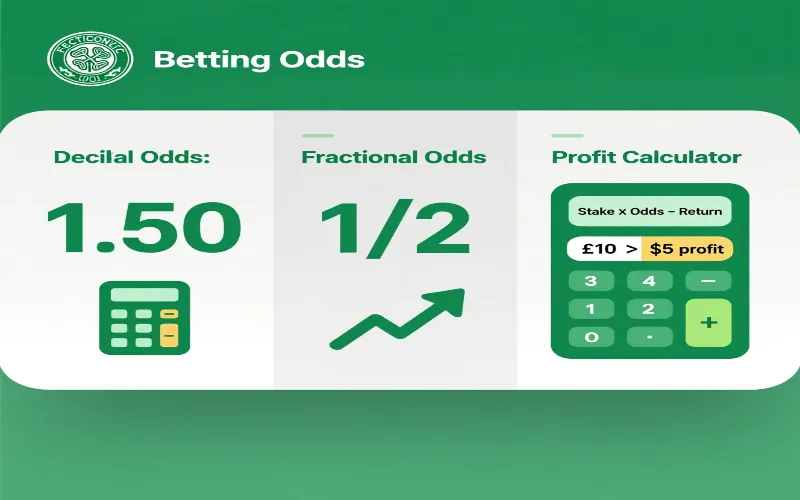
Understanding different betting odds formats and probability calculations
Decimal odds are the easiest to grasp. If Celtic are priced at 1.40 to beat Aberdeen, a £10 bet returns £14 total—your £10 stake plus £4 profit. The calculation is straightforward: stake multiplied by decimal odds equals total return. Fractional odds require an extra mental step. Celtic at 2/5 means you'll win £2 for every £5 staked, plus your stake back. Both formats represent the same thing, just expressed differently.
Here's what actually matters though: odds represent implied probability. When a bookmaker prices Celtic at 1.40, they're suggesting Celtic have roughly a 71% chance of winning (1 divided by 1.40). But—and this is crucial—that's not the true probability. Bookmakers build in a margin, often called the "vig" or "overround," which ensures they profit regardless of the outcome. If you add up the implied probabilities of all possible outcomes in a match, you'll find they exceed 100%, sometimes reaching 105% or more. That excess is the bookmaker's edge.
The key principle underlying all odds work is this: bookmakers are sophisticated, well-resourced, and extremely good at their jobs. Beating them consistently requires you to find edges they've missed or exploited market inefficiencies before they correct. This might sound daunting, but opportunities exist because bookmakers can't perfectly price every market at every moment. The trick is knowing where to look and being patient enough to wait for genuine value rather than forcing bets because a match is on television.
Remember that odds are not predictions—they're prices designed to attract balanced action on both sides of a wager. Bookmakers would ideally take equal money on Celtic to win, draw, and lose, allowing them to guarantee profit from their margin regardless of the result. When you see odds, you're not seeing what the bookmaker believes will happen; you're seeing what price makes commercial sense given their liability and information.
Essential Celtic Betting Markets
Match result betting—backing Celtic to win, draw, or lose—is where most people start, but it's arguably the least interesting market when Celtic are heavy favorites. When you're looking at odds of 1.15 for a Celtic home win against a bottom-half side, you're accepting minimal returns for what's still an uncertain outcome. Football throws up surprises constantly, and even overwhelming favorites lose sometimes. The question becomes: where else can you find value?

Explore diverse betting markets beyond simple match result wagers
Over/under goals markets offer more balanced odds and suit Celtic's playing style. Bookmakers typically set the line around 2.5 or 3.5 goals for Celtic matches. Given their attacking approach and the defensive frailties of many Scottish Premiership sides, Celtic games frequently produce goals. The trick is identifying when the line is set incorrectly based on the specific opposition. If Celtic are playing a team that attacks and leaves space, over 3.5 goals might offer value even at odds-against. Conversely, when facing a defensive-minded team that will pack the penalty area, under 2.5 goals occasionally makes sense despite Celtic's goal threat.
Both teams to score (BTTS) is a market I've grown fond of for Celtic matches, particularly in European competition. Celtic score regularly, but their aggressive high line and commitment to attacking football means they're vulnerable on the counter. Against quality opposition with pace, Celtic often concede even when winning comfortably. BTTS betting in Celtic's away European fixtures has historically offered decent value because the odds don't always reflect how open these games become.
Corner markets are overlooked by many bettors but can provide value in Celtic matches. Celtic's possession-based style and attacking commitment typically generate significant corner volume. When facing deep-lying defensive blocks, Celtic's crossing and wide play produce corners even if goals don't immediately follow. Betting on Celtic team corners over a certain threshold (say, six or more) or total match corners can offer reasonable odds and outcomes that are somewhat predictable based on playing styles.
Card markets require understanding both teams' disciplinary records and the referee's tendencies. Some referees are card-happy; others let the game flow. When Celtic face physically robust opponents who are likely to commit tactical fouls, the total cards market or specific player card bets become interesting. Conversely, mismatches where Celtic dominate possession often produce few cards because the opposition rarely needs to foul—Celtic have the ball constantly.
Accumulator bets—combining multiple selections into one bet where all must win—are popular but dangerous. The appeal is obvious: combine three Celtic match results at short odds, and suddenly you're looking at decent combined odds. The problem is variance. If you need three 80% probability events to all occur, you're actually looking at around 51% combined probability (0.8 × 0.8 × 0.8), yet the accumulator odds might imply 60% or 65% probability. Bookmakers build massive margins into accumulators, making them typically poor value despite the excitement of cheering multiple outcomes.
Goal markets can be split incredibly finely: first half goals, second half goals, goals in ten-minute intervals, team to score first, team to score last. Each variation offers different odds and requires different analysis. Celtic typically score more frequently in the second half as opponents tire and space opens up. If you've noticed this pattern and can find second half goal markets with odds that don't fully reflect Celtic's second-half dominance, that's an edge worth exploiting.
The variety of Celtic betting markets means there's always somewhere to look for value, even when the basic match result offers nothing appealing. The challenge is disciplining yourself to only bet when you've identified genuine value rather than forcing action because you want to have a stake in the match. Most professional bettors bet on a small fraction of available matches because most of the time, the odds correctly reflect the probabilities, leaving no edge to exploit.
Advanced Celtic Betting Strategies
Strategy begins with mindset, not mathematics. If you're betting on Celtic because you support them or because watching football is more exciting when you've got money on the outcome, you're entertaining yourself, not investing. Neither approach is wrong, but they require different frameworks. Entertainment betting accepts losses as the cost of enhanced enjoyment. Strategic betting treats losses as temporary variance within a long-term profitable system. Decide which you're doing before placing any bet.

Data-driven approach to developing winning betting strategies
Value betting is the foundation of any sustainable strategy. Every single bet should represent a situation where you believe the true probability of an outcome exceeds what the bookmaker's odds imply. When Celtic are 1.50 to beat Hearts and you genuinely assess their win probability at 75% (which would be 1.33 in odds), that bet has positive expected value. Make that bet 100 times with accurate probability estimates, and you'll profit overall despite inevitable losses along the way. The difficulty lies in honestly assessing probability without letting bias creep in.
Form analysis requires depth beyond just looking at results. Celtic winning their last five matches 3-0, 4-1, 2-0, 3-1, 3-2 tells you they're winning, but the margins reveal something more nuanced. That 3-2 win suggests defensive vulnerability despite the victory. Digging into expected goals (xG) data shows whether Celtic are outperforming their underlying metrics—scoring from low-quality chances through individual brilliance—or genuinely dominating. When a team consistently overperforms their xG, regression typically follows. Understanding when Celtic's form is sustainable versus fragile gives you an information edge.
Opposition analysis matters more than most bettors realize. Celtic beat Aberdeen 4-0 last month, so they'll do it again, right? Not necessarily. Maybe Aberdeen were missing three first-choice defenders. Perhaps they'd played Wednesday night in Europe. Or possibly they just had an unusually bad day. Context explains results in ways that raw scores don't. Analyzing how opponents set up tactically against Celtic—whether they attack and leave space or defend deep and compact—helps predict what kind of match we'll see. Celtic struggle more against teams that defend compactly, which creates betting opportunities on lower-scoring outcomes despite Celtic being heavy favorites.
One advanced angle: betting against Celtic in strategically unimportant matches late season when the title is already secured. Celtic's motivation plummets if the championship is wrapped up with three matches remaining. They're mentally on holiday already, fielding weakened teams and playing without intensity. Opposition sides fighting relegation or chasing European qualification, meanwhile, are playing for their lives. The quality gap remains, but motivation can temporarily overcome it. Finding these spots requires following the league table and understanding what's actually at stake for each team.
Key Factors Influencing Celtic Betting
Squad rotation becomes inevitable when Celtic are competing across multiple fronts. The Scottish Premiership, Scottish Cup, League Cup, and European competition create congested schedules that no squad can navigate at full strength throughout. Brendan Rodgers typically prioritizes the Premiership and European football, which means domestic cup matches, especially early rounds, see heavily rotated sides. When Celtic field eight changes against lower-league opposition in the Scottish Cup, suddenly that 1.10 price on Celtic to win doesn't look quite so appealing. Tracking rotation patterns gives you information about when Celtic are genuinely vulnerable despite their superior overall squad.
Injuries and suspensions impact all teams, but Celtic's reliance on certain players creates betting implications when key men are absent. If Callum McGregor is suspended and missing from central midfield, Celtic's control of matches diminishes. If their first-choice striker is injured, the goal threat reduces even if the replacement is capable. Following Celtic's team news religiously—checking press conferences, monitoring training reports, and staying plugged into reliable journalists—gives you a time advantage. Early information about absences lets you bet before the market fully adjusts, capturing better odds.

Celtic Park's intimidating atmosphere provides significant home advantage
Home advantage at Celtic Park is genuine and quantifiable. The capacity crowd, intimidating atmosphere, and familiarity with the pitch dimensions all favor Celtic. Their home record in domestic competition typically shows win rates above 85%, which bookmakers price into the odds accordingly. However, the magnitude of home advantage varies by opponent. When Celtic host Rangers in an Old Firm derby, the home advantage might be worth half a goal. When they host Ross County, it might be worth a full goal or more because County's players are intimidated by the occasion. Understanding the psychological dimension of home advantage helps you assess whether the odds correctly reflect its impact.
Contract situations occasionally impact performance. When key players are in the final year of their contracts and transfer speculation is intense, their focus can waver. Similarly, when a star player has just signed a new long-term deal, there's often a bounce in performance as security and commitment align. These psychological factors are subtle but can create short-term edges if you're paying attention to developments off the pitch.
Celtic's recent results against specific opponents create psychological legacies. If Celtic have beaten Aberdeen 4-0 in their last three meetings, Aberdeen's players arrive defeated before kick-off. Conversely, if a particular team has managed to frustrate Celtic or even beat them recently, they carry confidence into the fixture. Head-to-head history matters psychologically, and while it shouldn't override current form and quality gaps, it's another variable worth considering when evaluating betting value.
Old Firm Derby: Special Betting Considerations
The Old Firm derby between Celtic and Rangers isn't just another match—it's a cultural event that transcends sport. Betting on these fixtures requires a completely different framework because conventional form analysis becomes almost irrelevant. I've seen Celtic dominate the league, arrive at Ibrox as overwhelming favorites, and promptly lose because the occasion overwhelms tactics. Form goes out the window when these two collide.
Historical statistics from Old Firm derbies reveal high-scoring affairs with plenty of cards, corners, and drama. Both teams approach these matches with maximum intensity, attacking ambition, and a refusal to cede psychological ground. The result is often open, end-to-end football that produces goals at both ends. Over 2.5 goals is frequently a sharper bet than trying to predict the match result because both teams commit forward regardless of the score, leaving space for counter-attacks. Similarly, both teams to score has historically offered value because defensive caution is minimal in these emotional pressure cookers.
Risk management for Old Firm betting should be more conservative than your standard approach. Because these matches are unpredictable and variance is high, staking should be reduced. If you typically bet 2% of your bankroll on routine matches, consider 1% or even 0.5% for Old Firm fixtures. The uncertainty premium is real, and protecting your bankroll from the inevitable variance spikes these matches produce is smart bankroll management.
Betting syndicates and professional bettors sometimes avoid Old Firm matches entirely because the edge is minimal and variance is maximum. When even professionals struggle to find consistent value, that tells you something about the market efficiency. However, for those who enjoy the strategic challenge and accept higher variance, Old Firm derbies offer a laboratory for testing your ability to analyze matches where conventional wisdom breaks down. Just don't expect to dominate these fixtures profitably without significant experience and discipline.
Celtic Betting Toolkit
Three tools from this guide: check whether your win rate is actually profitable, size down for Old Firm variance, and adjust Celtic's price for the competition context.
The guide's own example: an 80% win rate at 1.15 odds still loses money long-term, while a 40% win rate at 3.00 odds can be genuinely profitable. Win rate alone tells you nothing — this checks the actual expected value.
The guide recommends cutting a normal 2% stake to 1% or even 0.5% for Old Firm derbies, since variance runs far higher than in a routine Celtic fixture.
Grounded in the guide's own examples: it argues a domestic away price implying 85% should really be closer to 75%, and that an 8-changes cup line of 1.10 does not reflect the real risk. This applies a similar-sized haircut for each context.
This tool applies the framework from this guide for general and educational purposes only — it is not betting advice and does not guarantee results. Always gamble responsibly. Support: BeGambleAware.org, GamCare.org.uk.
Choosing the Best Celtic Betting Sites
Not all bookmakers are created equal, and where you place your Celtic bets matters more than you might think. Odds variations, market availability, and platform reliability create meaningful differences in long-term profitability. Let's cut through the marketing noise and focus on what actually matters when choosing where to bet.
Licensing and regulation come first, full stop. Only bet with bookmakers licensed by reputable authorities—the UK Gambling Commission being the gold standard. Licensed operators must meet strict financial solvency requirements, keep customer funds segregated, and submit to regular audits. Unlicensed offshore sites might offer tempting odds or bonuses, but when withdrawal problems arise, you have zero recourse. The peace of mind of knowing your money is secure justifies any minor odds differences.
Odds comparison reveals just how much bookmakers vary on identical markets. Celtic to beat Aberdeen might be 1.40 at bet365, 1.44 at Betfair, and 1.47 at Paddy Power. Over 100 bets, consistently taking the best available price adds hundreds, potentially thousands, to your returns. Maintain accounts with five or six major bookmakers—bet365, William Hill, Betfair, Paddy Power, Ladbrokes, and Coral cover most bases—and spend three minutes comparing before every bet. It's tedious but profitable.
Market variety matters if you're betting beyond simple match results. Some bookmakers offer extensive player props, alternative handicaps, and niche markets; others stick to basics. If your strategy involves Asian handicaps or specific player markets, verify that your chosen bookmaker actually offers these consistently. There's nothing worse than identifying a value bet only to discover your bookmaker doesn't offer that market for Celtic matches.
Live streaming availability enhances the betting experience enormously, especially for in-play betting. Being able to watch Celtic matches directly through your betting account while simultaneously placing bets is invaluable. bet365 leads here, offering extensive live streaming for UK customers who have funded accounts or placed recent bets. Betfair also provides solid coverage. If in-play betting is central to your strategy, prioritize bookmakers with quality streams.
Mobile apps are non-negotiable in modern betting. You're not always at a computer when team news breaks or odds shift. Quality mobile apps—fast, intuitive, and offering the same functionality as desktop sites—let you capitalize on opportunities wherever you are. Test multiple bookmaker apps to find which interfaces you prefer. Poor app experiences lead to missed bets or errors that cost money.
Welcome bonuses and promotions look attractive but read the terms carefully. "Bet £10, Get £30 in Free Bets" sounds generous until you discover the free bets must be used on accumulators with minimum 4.0 odds, expire in seven days, and exclude winnings from stake returns. Some bonuses genuinely add value; others are marketing gimmicks with restrictions that make them near-worthless. Evaluate bonuses by calculating their actual expected value under the stated terms, not their headline numbers.
Choosing the best bookmaker is personal—it depends on your betting style, stake levels, and preferences. Someone betting £10 per match on simple outcomes has different needs than someone placing £500 on Asian handicaps. My recommendation: open accounts with three to five bookmakers, use them all initially, and gradually identify which ones offer the best combination of odds, markets, and user experience for your specific approach. Flexibility and options beat loyalty when your money is on the line.
Common Celtic Betting Mistakes to Avoid
Betting with your heart instead of your head kills more bankrolls than any other mistake. If you're a Celtic supporter, backing them every match feels natural—you want them to win, so why not profit when they do? The problem is fan bias clouds judgment. You overestimate Celtic's chances, underweight opponent quality, and ignore warning signs that would make you hesitate if you weren't emotionally invested. The painful truth is you might be a better Celtic bettor if you don't actually support them, because objectivity becomes possible.
Chasing losses is the classic tilt mistake. Celtic lose unexpectedly to St Mirren, costing you £50. Your immediate instinct is to bet £100 on their next match to recoup losses quickly. This is emotional, not strategic. That next match has the same uncertainty as any other; your loss doesn't make Celtic more likely to win. Chasing leads to over-staking on sub-optimal opportunities, compounding losses when variance continues running against you. Losses are information and variance, nothing more. Process them, learn if necessary, and move forward according to your strategy without emotion.
Ignoring value in pursuit of winners is subtle but deadly. You back Celtic at 1.15 twenty times and win sixteen, losing four. That's an 80% win rate—sounds great, right? Except you've broken even or lost money because your winners returned 15% profit while your losers cost you 100%. Win rate doesn't matter; profitability does. A 40% win rate backing underdogs at 3.00 odds can be more profitable than an 80% win rate backing favorites at 1.25. Focus on long-term expected value, not short-term winning percentage.
Over-betting your bankroll on perceived "sure things" guarantees eventual ruin. Celtic at home against relegation-threatened opposition looks unlosable, so you bet 20% of your bankroll instead of your usual 2%. Then Celtic draw 0-0 in a frustrating stalemate, and you've vaporized a fifth of your bankroll on one match. Nothing is a sure thing in football. Upsets happen constantly. Disciplined stake sizing protects you from the inevitable variance that even heavy favorites face.
Neglecting to shop for best odds costs you money every single day you bet. Taking Celtic at 1.40 when they're available at 1.47 elsewhere is literally giving away profit. Three minutes of comparison work before each bet compounds enormously over dozens or hundreds of bets annually. This isn't sexy or exciting, but it's one of the easiest edges available to bettors who can be bothered to put in minimal effort.
Betting on every Celtic match because they're playing today forces action when no value exists. Professional bettors bet on maybe 10% of available opportunities because most of the time, odds are efficient and no edge exists. When Celtic are playing, you don't have to bet. If the odds don't represent value or you don't have an informed opinion, sitting out is a profitable decision. Boredom shouldn't drive betting decisions.
Trusting random tipsters on social media is a shortcut to losses. Someone posts on Twitter that they have "inside information" about Celtic's lineup or claims a 90% win rate on their premium tips. It's almost certainly nonsense. Anyone genuinely able to beat the bookmakers long-term doesn't need to sell tips; they're betting themselves. Do your own analysis, develop your own opinions, and never risk money based on someone else's claims without independent verification.
Letting recent results dominate your analysis creates recency bias. Celtic win 5-0, so they'll obviously dominate next match too, right? Not necessarily. That 5-0 might have been against a team reduced to nine men. Or Celtic overperformed their expected goals massively and won't repeat that efficiency. Similarly, one bad result doesn't mean Celtic are in crisis. Weigh recent results within broader context rather than letting the last match disproportionately influence your thinking.
Celtic Betting Tips for 2026 Season
Celtic enter the 2026 season as Scottish Premiership favorites yet again, which creates both opportunities and challenges for bettors. The familiarity of Celtic's domestic dominance means bookmakers price them efficiently in most league matches, requiring you to look deeper for value rather than simply backing them blind. Let's examine where opportunities might exist this season.
European competition remains Celtic's Achilles heel and simultaneously their most interesting betting angle. Celtic's Champions League or Europa League participation creates fixtures where their odds often don't fully reflect the step up in opposition quality. When Celtic travel to face continental opposition, particularly teams from Europe's top five leagues, backing against Celtic or exploring markets like both teams to score offers more value than you'll find in Scottish Premiership matches. Celtic's attacking ambition in European away fixtures frequently leaves them vulnerable defensively, even when they compete admirably.
Away fixtures against bottom-half teams occasionally present value, particularly if public sentiment has pushed Celtic's odds too short. When Celtic travel to face relegation-threatened sides fighting for survival, motivation imbalances sometimes surprise. Celtic are the better team and will win most of these fixtures, but the odds should reflect maybe 75% win probability, not 85%. Identifying when bookmakers have overcorrected toward Celtic favorites creates value opportunities.
In-play betting during Celtic matches remains one of the sharper approaches because odds swing based on short-term match state that doesn't always reflect true probabilities. If Celtic concede first against inferior opposition, their odds lengthen dramatically despite them still being clear favorites with ample time to respond. Conversely, when Celtic score early and the match opens up, betting on further goals can offer value as both teams commit forward. Reading match flow and having conviction to bet against apparent momentum requires experience but creates edges that pre-match betting can't access.
Betting against Celtic in late-season dead-rubber fixtures when the title is already secured presents annual opportunities. When Celtic mathematically clinch the championship with several matches remaining, motivation evaporates. They're mentally preparing for summer holidays and European qualifiers, not grinding out wins against teams they outclass. Opposition sides, meanwhile, might be fighting relegation or chasing European qualification, bringing maximum intensity. The quality gap remains, but temporary motivation imbalances can overcome it, creating value betting against Celtic in these specific scenarios.
Monitoring Celtic's transfer activity—both incoming and outgoing—provides betting intelligence. If Celtic sell a key player mid-season or sign a game-changing attacker, the market takes time to adjust odds appropriately. Being aware of squad changes before they're fully priced into betting markets gives you an information window where value exists. Similarly, managerial changes or coaching staff departures affect team cohesion and performance, creating temporary betting opportunities for those paying attention.
The bookmaker promotions and odds boosts around big Celtic matches sometimes offer genuine value, particularly for new customer offers. If you're willing to open accounts with multiple bookmakers throughout the season, targeting enhanced odds promotions—"Celtic to Win, Boosted from 1.40 to 1.70"—can be profitable. Just verify the terms allow you to actually extract value rather than being marketing illusions with restrictive conditions.
Building a systematic approach to Celtic betting in 2026 means identifying your edge—whether that's specializing in certain markets, competitions, or situations—and exploiting it consistently rather than betting on every Celtic match out of habit or entertainment. Successful betting is boring: it's finding an advantage, applying it repeatedly, tracking results, and adjusting when evidence suggests your edge has disappeared. Celtic offer plenty of betting opportunities; the challenge is distinguishing genuine value from familiar comfort.
Responsible Gambling
Betting should enhance your enjoyment of football, not dominate your life or finances. Every single resource that discusses betting should address responsible gambling not as an afterthought but as a foundation, so let's be direct about what that means in practice.

Maintaining healthy balance between entertainment and responsible gambling practices
Set deposit limits before you ever place a bet. Decide an amount you can afford to lose—genuinely afford, where losing it wouldn't affect your rent, bills, food, or obligations—and treat that as your betting bankroll. If it's £100, great. If it's £1,000, fine. The amount matters less than the ironclad rule that you don't deposit more when you lose it. Betting bankrolls should be segregated money that exists solely for this purpose, replenished only from winnings or planned monthly entertainment budgets, never from "borrowed" money meant for other purposes.
Warning Signs: Chasing losses, betting with money you can't afford to lose, lying to family about betting activity, or feeling gambling is your primary source of excitement are red flags. If you're betting to escape stress or depression rather than for entertainment, you've crossed from hobby into problem territory.
Seek help if you suspect gambling has become problematic. Organizations like BeGambleAware, GamCare, and Gamblers Anonymous provide free, confidential support. There's no shame in reaching out—problem gambling is a recognized condition, not a character flaw. The longer you wait to address it, the more damage accumulates financially, relationally, and psychologically. Early intervention dramatically improves outcomes.
Be honest with yourself about your motivations. Are you betting because you genuinely enjoy the strategic challenge and can handle losses emotionally? Or are you betting to feel excitement, escape boredom, or chase an idealized fantasy of easy money? Honest self-assessment about why you bet determines whether it remains a healthy hobby or slides into problematic behavior.
Betting on Celtic matches—or any team—should enhance your enjoyment of the sport, not become a necessity for matches to feel meaningful. If you can't enjoy watching Celtic play without money on the outcome, that's a dependency worth examining. Football existed and was entertaining long before betting apps made wagering trivially easy; it remains entertaining without financial risk.
FAQ
Celtic betting odds show the bookmaker’s pricing of likely outcomes. Decimal odds such as 1.50 mean a £10 bet returns £15 total, including stake. Odds also imply probability, but bookmakers include a margin, so the combined implied probabilities exceed 100%. The goal is to find situations where your estimate of Celtic’s true probability is higher than the probability implied by the bookmaker’s odds.
Important factors include injuries and suspensions, fixture context, squad rotation, home or away advantage, opponent quality and motivation, recent form, competition type, and broader factors such as title pressure or tactical matchups. Successful Celtic betting depends on assessing the interaction of several variables rather than relying on one single factor.
The best market depends on the specific match, but Asian handicaps, over and under goals, both teams to score, player props, and corner markets often provide better value than simple match result bets when Celtic are heavy favorites. In domestic mismatches, handicap and goal markets are often more attractive, while in competitive or European fixtures, both teams to score and player-related markets may offer stronger value.
Conclusion
Betting on Celtic FC successfully requires far more than recognizing they're a quality team dominating Scottish football. It demands understanding when that quality translates into betting value versus when you're simply paying inflated prices for the privilege of backing favorites. The difference between profitable Celtic betting and slowly hemorrhaging your bankroll often comes down to patience—waiting for genuine value opportunities rather than forcing bets because Celtic happen to be playing.
Throughout this guide, we've explored Celtic from multiple angles: how odds work and what they actually represent, which betting markets offer the best risk-reward balance, strategies that separate casual from serious bettors, and the countless factors influencing match outcomes. We've addressed the unique dynamics of Old Firm derbies, compared bookmaker options, highlighted common mistakes that sabotage profitability, and emphasized responsible gambling principles that should underpin everything.
Key Takeaway: Value beats volume. Betting on fifteen Celtic matches per month at poor odds guarantees long-term losses. Betting on three carefully selected situations where you've identified genuine value offers realistic profit potential.
Celtic will continue providing betting opportunities throughout the 2026 season and beyond. Your success depends not on blind loyalty or hoping for the best, but on systematic thinking, emotional discipline, and ruthless honesty about when you actually have an edge versus when you're just entertaining yourself. Both are valid approaches, but only one builds bankrolls over time.
Remember that every bookmaker is operating with professional algorithms, massive data sets, and margins designed to ensure they profit long-term. Beating them isn't impossible—thousands of bettors prove otherwise—but it requires treating betting as a skill to develop rather than a lottery to play. Study matches, track your results, learn from losses, and never stop refining your approach.
Whether you're backing Celtic at Parkhead, exploring European away fixtures, or cautiously navigating Old Firm derbies, bring the same rigor to your betting that Celtic bring to their pursuit of silverware. Research thoroughly, bet selectively, manage your bankroll conservatively, and always, always prioritize sustainable approaches over short-term excitement. That's how you transform from someone who occasionally punts on Celtic into someone who approaches it with genuine strategic advantage.
Now get out there and find some value. Just remember that sometimes the best bet is no bet at all.
